
Cleanrooms are described in two ways, and buyers in India meet both. ISO 14644-1 sorts rooms into classes by how many airborne particles a cubic metre of air may hold. GMP rules for medicines, the EU's Annex 1 and India's revised Schedule M, sort them into grades A to D. How the room is built is a third question, about walls and pressure rather than cleanliness. This guide covers all three, with the numbers taken from the source documents.
ISO 14644-1 cleanroom classes
ISO 14644-1:2015 is the current edition. It defines nine classes, from ISO 1 (the cleanest) to ISO 9, by the maximum number of particles per cubic metre at sizes from 0.1 µm to 5 µm (microns). The limits are cumulative: the figure in the ≥0.5 micron column counts every particle of 0.5 µm and larger. A class is always stated with the room's occupancy state: as built, at rest or in operation.
| ISO class | ≥0.1 micron | ≥0.2 micron | ≥0.3 micron | ≥0.5 micron | ≥1 micron | ≥5 micron |
|---|---|---|---|---|---|---|
| ISO 1 | 10 | – | – | – | – | – |
| ISO 2 | 100 | 24 | 10 | – | – | – |
| ISO 3 | 1,000 | 237 | 102 | 35 | – | – |
| ISO 4 | 10,000 | 2,370 | 1,020 | 352 | 83 | – |
| ISO 5 | 100,000 | 23,700 | 10,200 | 3,520 | 832 | – |
| ISO 6 | 1,000,000 | 237,000 | 102,000 | 35,200 | 8,320 | 293 |
| ISO 7 | n/a | n/a | n/a | 352,000 | 83,200 | 2,930 |
| ISO 8 | n/a | n/a | n/a | 3,520,000 | 832,000 | 29,300 |
| ISO 9 | n/a | n/a | n/a | 35,200,000 | 8,320,000 | 293,000 |
Maximum particles per m³. A dash means the standard sets no limit at that size, because counts are too low to classify reliably; n/a means limits do not apply, because concentrations are very high. ISO 5 has no 5 µm limit in the 2015 edition (the 1999 table gave 29); large particles can instead be described with the "M" descriptor. ISO 9 applies only in operation. Every value follows the formula Cn = 10^N × (0.1/D)^2.08, where N is the class number and D the particle size in µm.
What "Class 100" means today
Class 100, Class 10,000 and Class 100,000 come from the US Federal Standard 209E, which counted particles of 0.5 µm and larger per cubic foot. The US government cancelled it on 29 November 2001, and ISO 14644 took its place. The old names survive in trade language in India, as in "Class 100 LAF" or "Class 10,000 room", partly because the US FDA's aseptic processing guidance of 2004 still writes both labels, for example "Class 100 (ISO 5)". The equivalents are close but not exact: Class 100 works out to about 3,530 particles per m³, against 3,520 for ISO 5.
| FS 209E class | Particles ≥0.5 micron per cubic foot | Nearest ISO class |
|---|---|---|
| Class 1 | 1 | ISO 3 |
| Class 10 | 10 | ISO 4 |
| Class 100 | 100 | ISO 5 |
| Class 1,000 | 1,000 | ISO 6 |
| Class 10,000 | 10,000 | ISO 7 |
| Class 100,000 | 100,000 | ISO 8 |
On a specification or URS, write the ISO class, for example "ISO 5 (Class 100)", and state whether it applies at rest or in operation.
GMP grades A, B, C and D
Pharmaceutical GMP uses four grades. EU GMP Annex 1 (2022) defines them as follows:
- Grade A: the critical zone for high-risk operations, such as aseptic filling, stopper bowls, open primary packaging and aseptic connections. It is normally provided by unidirectional airflow, inside RABS or isolators.
- Grade B: the background cleanroom for Grade A, where Grade A is not an isolator.
- Grades C and D: the less critical stages of aseptic manufacture, the background for isolators, and the preparation and filling of terminally sterilised products.
Each grade is classified in two states. At rest, the HVAC and equipment are installed and working but the equipment is not operating and nobody is in the room. In operation, the equipment runs in its defined mode with the maximum number of people present doing, or simulating, routine work.
Annex 1 (2022) and revised Schedule M: the particle limits
India's revised Schedule M (G.S.R. 922(E), December 2023) prints the grade table of the 2008 EU Annex 1 and WHO TRS 961. The EU revised its table in Annex 1 (2022), in force since 25 August 2023, and WHO adopted the same values in TRS 1044. The 0.5 µm limits are the same in both; the 5 µm limits differ.
| Grade and state | ≥0.5 micron, both texts | ≥5 micron, Annex 1 2022 classification | ≥5 micron, Annex 1 2022 monitoring | ≥5 micron, Schedule M |
|---|---|---|---|---|
| Grade A, at rest | 3,520 | Not specified | 29 | 20 |
| Grade A, in operation | 3,520 | Not specified | 29 | 20 |
| Grade B, at rest | 3,520 | Not specified | 29 | 29 |
| Grade B, in operation | 352,000 | 2,930 | 2,930 | 2,900 |
| Grade C, at rest | 352,000 | 2,930 | 2,930 | 2,900 |
| Grade C, in operation | 3,520,000 | 29,300 | 29,300 | 29,000 |
| Grade D, at rest | 3,520,000 | 29,300 | 29,300 | 29,000 |
| Grade D, in operation | Set by the site (Annex 1); not defined (Schedule M) | Set by the site | Set by the site | Not defined |
Maximum particles per m³. Annex 1 (2022) separates classification (its Table 1) from routine monitoring (its Table 5), and the 5 µm limits for Grades A and B return only in the monitoring table, so some summaries quote 29 for both. At 0.5 µm, Grade A is close to ISO 5, Grade B to ISO 5 at rest and ISO 7 in operation, Grade C to ISO 7 at rest and ISO 8 in operation, and Grade D to ISO 8 at rest. Schedule M calls Grade A "ISO 4.8" because of its limit of 20 particles at 5 µm.
CDSCO's circular of 7 August 2024 asks sterile and vaccine manufacturers to work towards WHO TRS 1044 after a gap analysis, but as of October 2026 the Gazette text of Schedule M has not been amended to the 2022 values. Check which table your inspector, client or export market works to before you fix acceptance limits.
| Grade | Air sample (CFU/m³) | Settle plate, 90 mm (CFU/4 h) | Contact plate, 55 mm (CFU/plate) | Glove print (CFU/glove) |
|---|---|---|---|---|
| Grade A | No growth | No growth | No growth | No growth |
| Grade B | 10 | 5 | 5 | 5 |
| Grade C | 100 | 50 | 25 | – |
| Grade D | 200 | 100 | 50 | – |
Microbial limits use the same numbers in both texts. Annex 1 (2022) treats them as maximum action limits and writes "no growth" for Grade A; Schedule M gives them as recommended average values and writes "less than 1".
Annex 1 (2022) also sets the longest interval between requalifications: 6 months for Grade A and B areas and 12 months for Grade C and D. Requalification covers at least classification, filter integrity, airflow volume, pressure differences and air velocity. Schedule M sets an interval only for HEPA leak testing: every six months recommended, and not more than twelve.
Which operations go in which grade
| Grade | Aseptic processing (examples) | Terminally sterilised products (examples) |
|---|---|---|
| Grade A | Aseptic filling and sealing, aseptic connections after the sterilising filter, aseptic compounding, loading a lyophiliser | Filling, when the product is unusually at risk |
| Grade B | Background for Grade A; moving protected equipment and components into Grade A | – |
| Grade C | Preparing solutions to be filtered, including sampling and dispensing | Filling; preparing solutions when unusually at risk; ointments, creams, suspensions and emulsions before sterilisation |
| Grade D | Cleaning equipment; handling cleaned components; assembling cleaned components under HEPA-filtered air before sterilisation | Preparing solutions and components for later filling |
Based on Annex 1 (2022), Tables 3 and 4; Schedule M Part II, 4.11 follows the same structure. Tablets and capsules are different: Schedule M Part VIII sets no ISO class or grade for oral solid dosage areas. It asks for dust control, filtered air, airlocks and change rooms, with the final change-room stage at the grade of the area it leads to. Many tablet and capsule plants design rooms with exposed product to ISO 8 at rest, similar to Grade D. That is common practice, not a Schedule M requirement.
Airflow and air changes
Grade A and ISO 5 zones use unidirectional airflow, which Annex 1 notes was previously called laminar airflow. The guidance velocity is 0.36 to 0.54 m/s at the working position, and Schedule M gives the same band. Grade B, C and D rooms, like ISO 6 to 8 rooms, use non-unidirectional (mixed) airflow that dilutes particles. The usual pharma arrangement is a unidirectional Grade A zone, such as a laminar air flow unit or a filling-line canopy, inside a Grade B room. Our guide to laminar air flow, biosafety cabinets, RLAF and fume hoods explains which unit protects what.
No regulator or ISO standard fixes air changes per hour. Schedule M says the number should suit the size of the room, the equipment and the people in it, and Annex 1 sets a clean-up time of under 20 minutes instead. Published guidance varies widely: the US FDA cites at least 20 air changes per hour for ISO 8 support rooms, WHO gives 6 to 20 for non-sterile areas, and industry figures put ISO 7 rooms at roughly 30 to 90. Your HVAC designer calculates the figure from heat load, occupancy and recovery time.
Types of cleanroom construction
Construction decides whether a room can hold its pressure and stand up to cleaning. Choose by the grade you need, the pressure cascade between rooms, the cleaning agents you use and how permanent the room has to be.
| Type | How it is built | Strengths | Limits | Typical use |
|---|---|---|---|---|
| Softwall | Steel frame with flexible PVC curtains; air escapes under the curtains | Lowest cost; quick to put up, move or extend | Holds very little positive pressure and no negative pressure; curtains are harder to clean | Local, non-pressurised ISO 7 to 8 zones and temporary work |
| Hardwall (rigid wall) | Rigid acrylic, PVC, polycarbonate or metal panels on a steel or aluminium frame | Holds positive pressure; better temperature and humidity control; easier to clean; can be moved | Costs more than softwall; plastic panels can scratch, and some disinfectants attack them | Cleaner zones with higher airflow, rooms that may be moved |
| Modular panel | Factory-made flush wall and ceiling panels, with doors, glazing and services built in | Smooth, sealed surfaces that take repeated disinfection; quick, clean installation; can be reconfigured | Higher material cost | GMP pharmaceutical rooms and suites |
| Stick-built | Conventional walls, for example gypsum board with epoxy paint, built on site | Lower first cost; easy to change late in the project | Construction dust; less tolerant of moisture and harsh cleaners; finish depends on site work; hard to rearrange | Permanent rooms where first cost matters most |
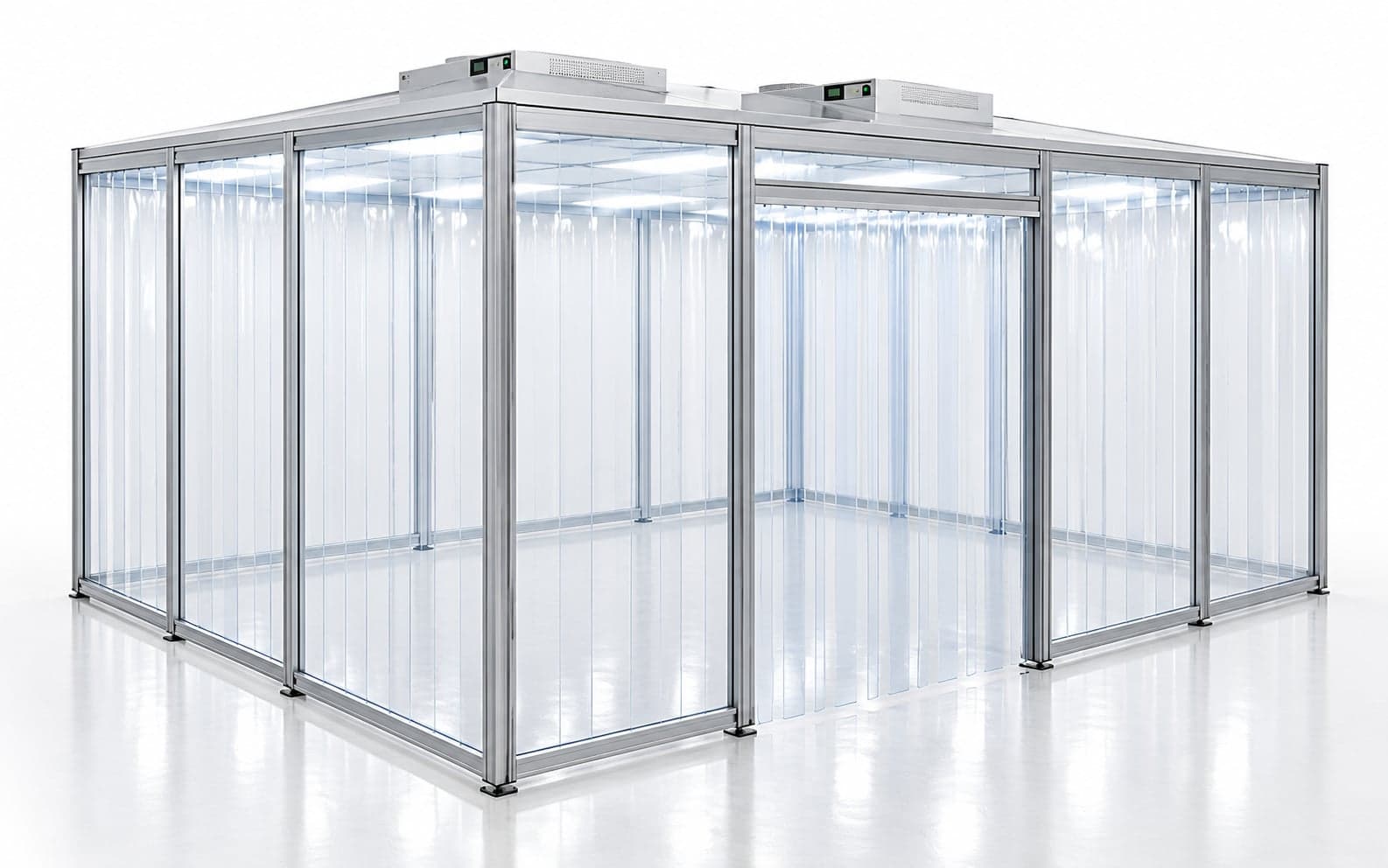
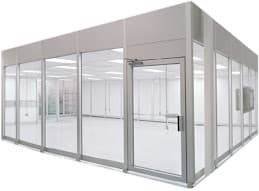
Whatever the construction, Annex 1 asks for smooth, impervious and unbroken surfaces, no recesses that are hard to clean, as few ledges, shelves and cupboards as possible, and materials that tolerate repeated cleaning and disinfection. The same applies to what goes inside the room, which is why cleanroom furniture is made of stainless steel with welded, rounded construction.
The rooms around a cleanroom
Every classified room needs a way in for people and a way in for materials. People enter through change rooms that act as airlocks; our change room guide sets out the gowning sequence and the equipment at each stage. Materials go in through pass boxes or material airlocks, so they do not share the personnel route. If you are upgrading an Indian plant, our revised Schedule M checklist maps each requirement to the equipment that serves it.
Questions to settle before you order equipment
- Which grade or ISO class each room needs, and in which state: at rest or in operation.
- Which grade table you work to: revised Schedule M, Annex 1 (2022) or WHO TRS 1044, or an export client's own.
- Whether a unit has to create a Grade A zone itself, as a laminar air flow unit or a biosafety cabinet does, or only stand in a classified room.
- The cleaning and disinfecting agents you use, so the stainless steel grade (SS 304 or SS 316) and finish suit them.
- The pressure differences and door interlocks needed for pass boxes and airlocks.
We make stainless steel cleanroom equipment and furniture for classified rooms at our factory in Pune: laminar air flow units, dispensing booths, pass boxes, air showers and change-room furniture. Send your room list and grades through our enquiry form and we will suggest equipment to suit.
Sources: ISO 14644-1:2015, Table 1; EU GMP Annex 1 (2022), Tables 1 to 6 and clauses 4.4 to 4.32; revised Schedule M, Part II, 4.3 to 4.11, and Part VIII; WHO TRS 1044, Annex 2; US FDA guidance on aseptic processing (2004); CDSCO circular of 7 August 2024.