Buyer's guide
Laminar air flow vs biosafety cabinet vs RLAF vs fume hood
Four units that look alike but protect different things. What each one protects, how its air moves, and which one your work needs.
The short answer
They protect different things
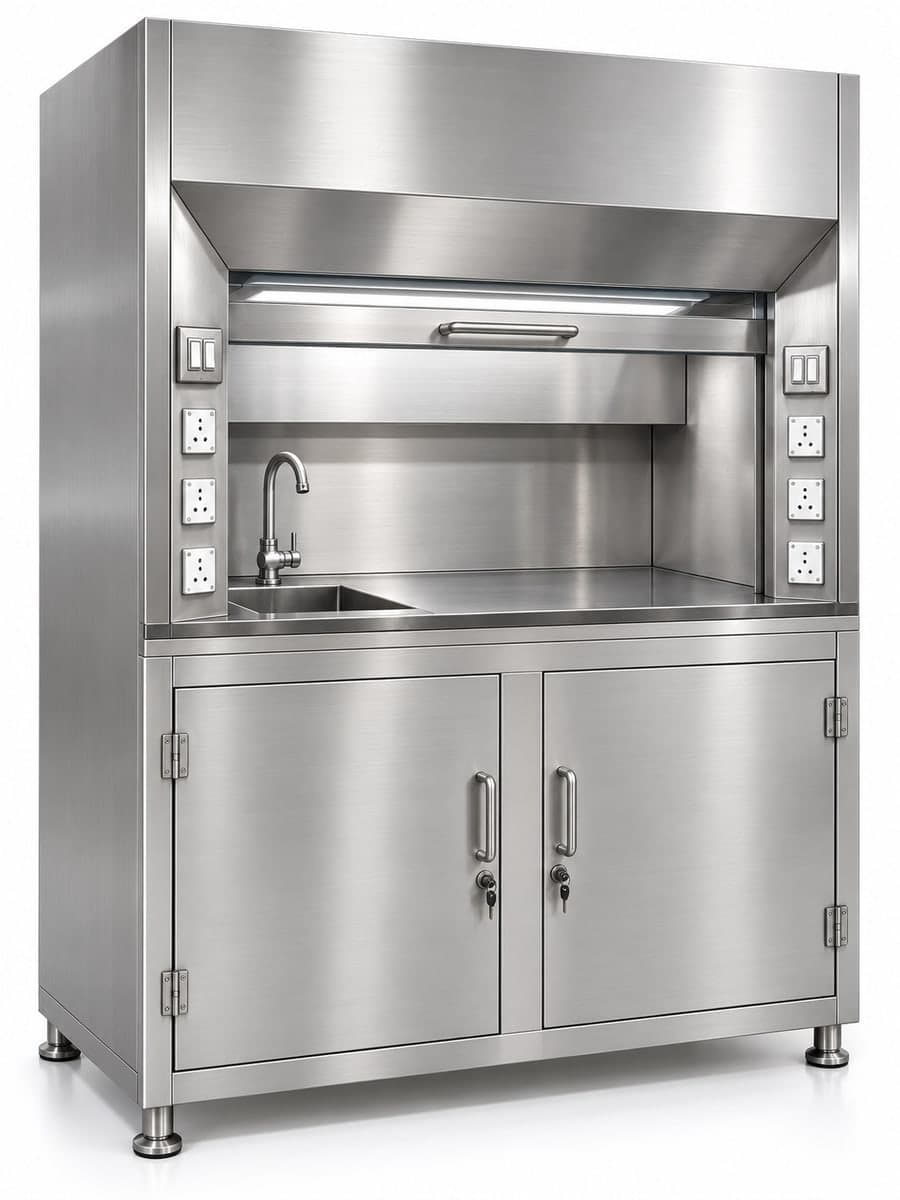
A laminar air flow (LAF) keeps the product clean, but its filtered air leaves through the front towards the operator, so it gives no operator protection. A biosafety cabinet (BSC) protects the product, the operator and the room when you work with micro-organisms. A dispensing booth, also called a reverse laminar air flow (RLAF) or downflow booth, carries powder dust down and away from the operator during weighing and sampling. A fume hood draws chemical fumes away from the operator and out of the building, but it does nothing to keep the sample clean.
So choose by asking two questions: what must be protected (the product, the operator or the room), and what is the hazard (particles, micro-organisms, powders or chemical vapours)? The table below answers both for each unit.
Side by side
What each unit protects and how its air moves
| Unit | Protects | How the air moves | Where the air goes | Typical use | Not for |
|---|---|---|---|---|---|
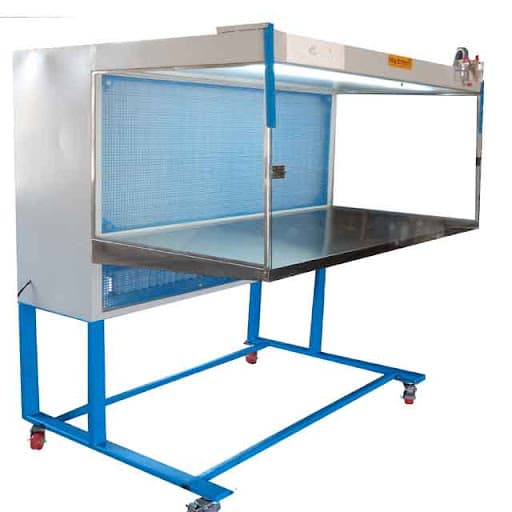
| Laminar air flow, horizontal or vertical | The product only | HEPA-filtered air flows across (horizontal) or down onto (vertical) the work, then out of the front towards the operator | Back into the room; there is no exhaust filter | Non-hazardous sterile work: media and plate preparation, sterile assembly, sample preparation | Micro-organisms, toxic or potent powders, cytotoxic drugs, volatile chemicals |
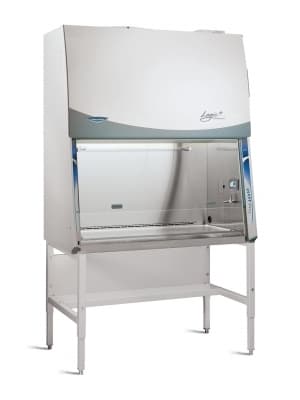
| Biosafety cabinet, Class II | The product, the operator and the room | Room air is drawn in at the front as an air curtain; HEPA-filtered air flows down over the work | Part is recirculated through the supply HEPA, part leaves through an exhaust HEPA (about 70/30 in type A cabinets) | Microbiology, cell culture, work with infectious or potentially infectious material | Volatile or flammable chemicals in recirculating types; chemical-only work |
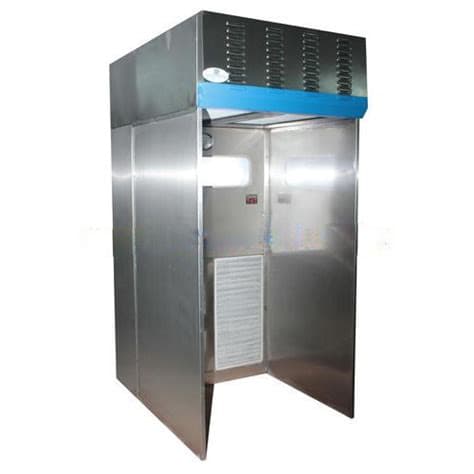
| Dispensing booth / RLAF | Mainly the operator, also the room; clean air over the material | HEPA-filtered air flows down from the ceiling past the operator into return grilles low at the back | Mostly recirculated; a small share is exhausted, keeping the booth slightly negative to the room | Weighing, dispensing and sampling of powders, APIs and excipients | Volatile solvents in recirculating mode, biological agents, potent compounds beyond the booth's tested containment |
| Fume hood | The operator, from vapours, gases and splashes | Room air is drawn in at the sash opening, over the work and into the duct | Outdoors through the duct, in a single pass; standard hoods have no HEPA filter | Volatile solvents, acids, chemical sample preparation | Sterile work, infectious agents |
How each one works
The units in more detail
Horizontal laminar air flow
A HEPA filter at the back blows clean air across the work surface and out of the open front. The sweep is smooth over small items, but anything placed downstream of a large object is less protected, and the air reaches the operator.
Vertical laminar air flow
The HEPA filter sits above the work and the air flows down onto it, then out at the front. It suits taller equipment and keeps the air from blowing straight at the operator, but it is still not rated for operator protection.
Biosafety cabinet
Room air drawn in at the front forms a curtain that keeps aerosols inside, HEPA-filtered air flows down over the work, and the exhaust leaves through a second HEPA filter. Class I protects the operator and room only, Class II all three, and Class III is a sealed glove box for the highest-risk agents.
Dispensing booth (RLAF)
Clean air flows down from a ceiling HEPA plenum past the operator's head and is drawn into return grilles low at the back, taking powder dust away from the breathing zone. Most of the air is recirculated through staged filters, and a small share is exhausted.
Fume hood
Room air drawn in at the sash opening sweeps fumes away from the operator and leaves through the duct to outdoors. The sash also guards against splashes. Face velocity is typically about 0.5 m/s, but only a containment test proves the hood works.
Choosing
Which one do you need?
Only the product must stay clean, and the material is not hazardous: a laminar air flow. Choose vertical flow for taller equipment or if you prefer the air not to blow at the operator, and horizontal flow for small items and a smooth sweep across the work.
Micro-organisms or potentially infectious material: a Class II biosafety cabinet. If small amounts of volatile chemicals are also involved, you need a ducted or total-exhaust type (B1 or B2), not a recirculating one. The highest-risk agents need a sealed Class III cabinet.
Powders the operator must not breathe during weighing, dispensing or sampling: a dispensing booth. For highly potent compounds, check whether a booth with screens or an isolator is needed.
Chemical fumes, with no need for a sterile work zone: a ducted fume hood.
Never use a laminar air flow for hazardous material, never rely on a fume hood to keep a sample clean, and never use volatile toxic chemicals in a recirculating biosafety cabinet.
Standards and tests
What you will see on a specification sheet
Cleanliness is stated as an ISO 14644-1 class or an EU GMP grade. ISO Class 5 allows at most 3,520 particles of 0.5 µm and larger per cubic metre, the same limit as Grade A. EU GMP Annex 1 (2022) calls these units unidirectional airflow (UDAF) units and gives 0.36 to 0.54 m/s at the working position as a guidance value, the familiar 0.45 m/s ± 20%.
Biosafety cabinets are built and tested to NSF/ANSI 49 (Class II) or EN 12469, which was revised in 2025. Fume hoods are tested to ASHRAE 110 or EN 14175. For every unit, the usual checks at installation and requalification are a HEPA filter leak test with a PAO or DOP aerosol, air velocity, airflow visualisation with smoke and a particle count. Biosafety cabinets also get an inflow test, and fume hoods a face velocity check and, where needed, a tracer-gas containment test.
Our laminar air flow units, dispensing booths, bio safety cabinets and dynamic pass boxes have a PAO port for the HEPA filter integrity test, and our laminar air flow is rated at 0.45 to 0.65 m/s. A UV lamp, where fitted, supplements cleaning and disinfection; it is not a sterilisation step.
Questions
F.A.Q.
Is a laminar air flow the same as a biosafety cabinet?
No. A laminar air flow protects only the product: its filtered air leaves through the front towards the operator. A biosafety cabinet adds an inward air curtain at the front and an exhaust HEPA filter, so it also protects the operator and the room. Never use a laminar air flow in place of a biosafety cabinet.
Is a dispensing booth the same as a reverse laminar air flow?
Yes. Dispensing booth, reverse laminar air flow (RLAF) and downflow booth are names for the same kind of unit: HEPA-filtered air flows down past the operator and is drawn away at low level, carrying powder dust away from the breathing zone.
Can I use volatile chemicals in a biosafety cabinet?
Not in a recirculating type: HEPA filters do not capture vapours, so they return to the work zone and the room. Small amounts need a ducted cabinet (type B1 or B2, or a canopy-connected A2 with an exhaust alarm). Chemical work with no biological hazard belongs in a fume hood.
Does a fume hood protect my sample?
No. A fume hood draws unfiltered room air across the work, so it protects the operator from vapours but does not keep the sample clean. Standard fume hoods have no HEPA filter, so they are not for infectious material either.
Is a dispensing booth suitable for aseptic work?
Not as a rule. A dispensing booth is designed for powder handling and operator protection. Use one for aseptic processing only if it has been specifically designed and qualified for that.
Which tests should be done after installation?
A HEPA filter leak test with a PAO or DOP aerosol, air velocity and uniformity, smoke visualisation of the airflow and a particle count against the class you need. Biosafety cabinets also need an inflow velocity test, and fume hoods a face velocity check. Repeat them at your site's requalification interval and after a filter change or relocation.
Not sure which one you need?
Tell us what you handle, in which room grade and in what quantities, and we will suggest the right unit and size.